
The first significant milestone in industrial refrigeration production through a thermodynamic cycle occurred in 1858 when ammonia was used as refrigeration liquid. However, it was not until the twentieth century when this technique became the industry we all know nowadays.
Over the last decades, industrial refrigeration focused on achieving improvements regarding energetic efficiency, new control and regulation system implementation, equipment monitoring and especially the use of new refrigeration fluids which are less polluting.
What is industrial refrigeration about?
Refrigeration is a process that consists of lowering or keeping heat levels within a place or figure. Technically, the concept of cooling does not exist. So refrigeration is a thermodynamic process in which the heat of an object is drawn (reducing its thermal levels) and it is carried to a different place where it can be released without causing any harm to the environment. The fluids used to carry thermal energy from one place to another are called refrigerants.
Refrigeration takes advantage of the fact that liquids evaporate at different temperatures depending on the changing air pressure, so, the lower the air pressure the easier the liquids evaporate at a low temperature. When they evaporate, there is a change that absorbs heat from the environment without increasing its temperature (latent heat).
Refrigeration types.
- Compression refrigeration: it is a refrigeration method that consists of mechanically forcing a refrigerant circulation within a closed circuit divided into two different zones: high and low pressure. The refrigerant acts as the means of transportation to carry the heat from the evaporator (low pressure zone), located in the area to be cooled, to the air condenser (high pressure zone) where it is released into the atmosphere or the coolant water, a water cooled condenser system in this case.
- Absorption refrigeration: it is another kind of refrigeration process which, to be able to produce cold, takes advantage of the substances that absorb the heat when changing state, in this case, from liquid to gas. However, contrary to the compression system which uses a compressor, the absorption system uses the capacity that some substances possess to absorb other substances in the evaporation phase.
Industrial refrigeration processes at installations.
Installations in which one can usually see industrial refrigeration processes are:
- Refrigeration systems for storage chillers and refrigerators, set in industrial warehouses for food storage or freezing food.
- Cooling control centres in retail as well as vending machines of both fresh and frozen food
- Air, sea and land cargo vehicles which require low temperature storage.
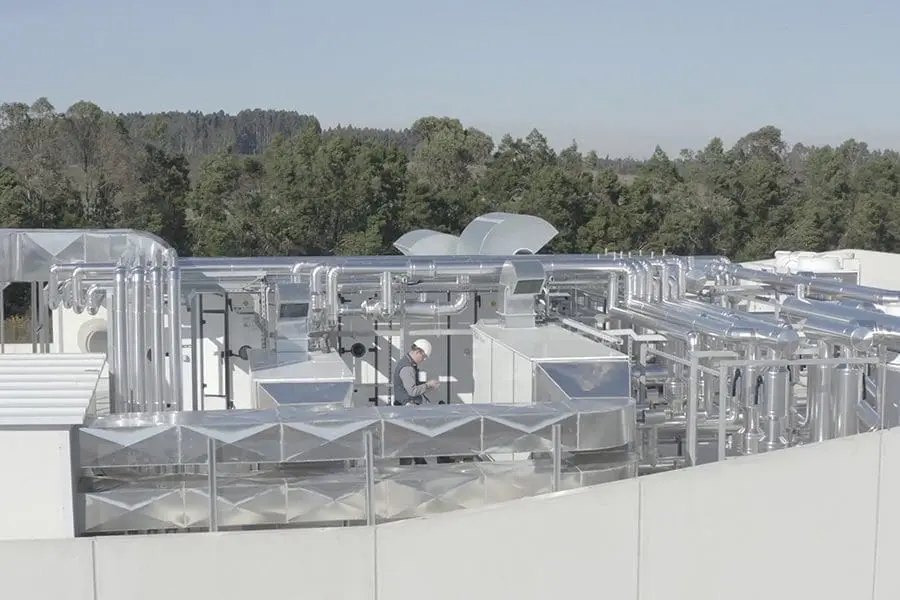
- Water cooling systems in buildings, hotels and hospitals. Technically these machines are climate control centralized systems. However, due to its power and capacity can perfectly be classified as industrial refrigeration equipment. What should not be considered as an industrial refrigeration process is direct expansion climate control equipment.
- Industrial refrigeration systems.
As you may have noticed, thermodynamics has a wide range of different uses in industrial processes which, amongst other things, has helped develop the way we eat.
We shall surely talk about refrigeration and thermodynamics on our blog. Please, leave a comment.
[rscontentoffer