
Air conditioning system installation for the textile industry is an area where Arce Clima has developed strong expertise, refined over three decades of global experience. Our projects span large commercial complexes and flagship stores to small businesses worldwide.
Every air conditioning installation is unique, requiring customization to the specific needs and characteristics of both the space and the business itself. The focus remains on achieving optimal efficiency, superior comfort, and energy savings. Critical to this process is selecting the right partner and equipment, as well as the ideal technology, tailored from the array of market options to align precisely with the demands of each application.
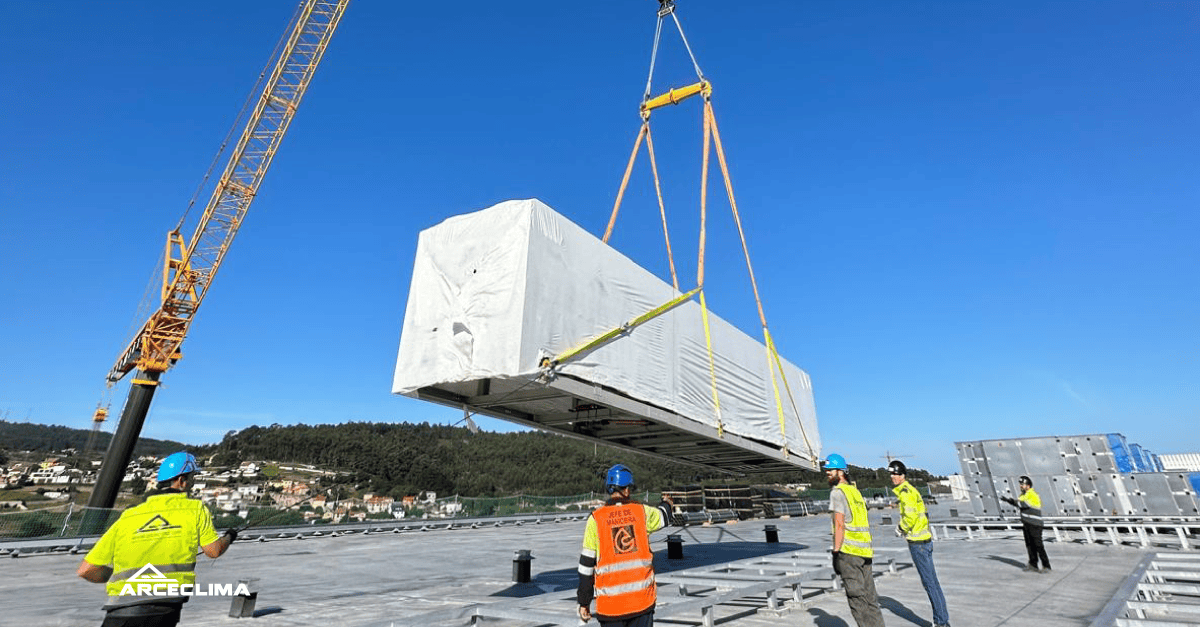
The air conditioning installation highlighted in this post utilized Daikin chillers. The project, conducted for a major retail company in Sabón (Arteixo, A Coruña), included a critical preliminary step: hoisting the chillers to the building’s rooftop. Each unit weighed 11 tons, a task our team executed with meticulous precision. The video below demonstrates the process.
Key details about the Daikin chillers deployed in this HVAC installation for a textile industry company
This high-capacity chiller is engineered to cool or heat water for HVAC systems in buildings or industrial applications. It utilizes R513A refrigerant to either extract or add heat to the water as needed, maintaining precise temperature control.
This machine serves two primary functions:
- Cooling water: Reduces water temperature from 12°C to 7°C.
- Heating water: Increases water temperature from 40°C to 45°C, even in cold environments (down to 2°C).
Sustainability Commitment
Environmental responsibility is a cornerstone of Arce Clima’s philosophy, integrated into every project and HVAC installation. These chillers employ R513A refrigerant, a solution with a drastically lower global warming potential (GWP) compared to legacy refrigerants like R134A or R22, positioning it as a more sustainable choice within today’s refrigerant options.
In addition, these machines earned strong energy efficiency ratings as measured by rigorous international standards, with an EER (Energy Efficiency Ratio) of 3.14, reflecting cooling output per kW of electricity consumed, and a COP (Coefficient of Performance) of 2.815, indicating heating output per kW. The TER (Total Efficiency Ratio) for combined efficiency stands at 7.04.
Built for Large-Scale Demands
The system employs two large compressors with adjustable power output and 16 fans to optimize airflow for heat exchange. Spanning over 8 meters in length and nearly 2.5 meters in height, this machine is engineered for expansive spaces requiring consistent, high-volume temperature control.